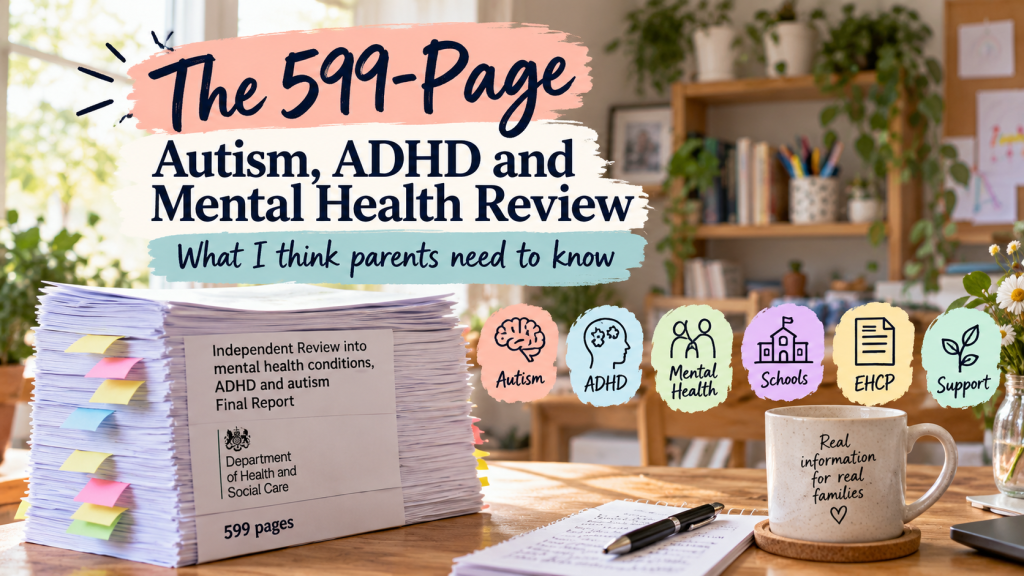
On 9 October 2026, the final report of the Independent Review into prevalence and support for mental health conditions, ADHD and autism was published.
It is 599 pages long.
And I have read enough SEND documents in my life to know that most parents do not have the time, energy or emotional bandwidth to sit down with 599 pages of policy, statistics and recommendations.
So this is not a line-by-line summary.
It is my parent-focused reading of the parts I think matter most if you are trying to get your child understood, supported and able to participate in everyday life.
The full report, executive summary and technical annex are available on the official GOV.UK publication page. Read the Independent Review on GOV.UK
Before anything else, one important distinction:
This is an independent review making recommendations. Publication of the report does not itself change the law, rewrite the SEND system or create new legal entitlements.
Some of its recommendations may go on to influence government policy. Some may not. What happens next — including what is actually funded and implemented — matters enormously.
But what the review says about the system families are navigating now is significant.
And its central argument is surprisingly simple:
People should not have to wait for a diagnosis before they can get help.
(Independent Review, Executive Summary, paras. 8–10.)
People should not have to deteriorate while waiting for a diagnosis
One of the review’s headline recommendations is that England should move from a “diagnosis-dependent” system towards what it calls a “needs-led plus diagnosis” system.
That wording is important.
The review is not saying diagnosis does not matter.
It says diagnosis can be clinically necessary, personally meaningful and important for treatment and understanding.
What it challenges is the sequence we have created:
Struggle → wait → assessment → diagnosis → finally receive support.
Instead, the review argues that support should be based on what a person needs and should be available before, during and after diagnostic assessment.
Later in the report it makes this even clearer: support and diagnosis should proceed in parallel rather than in strict sequence.
Practical help, reasonable adjustments, psychoeducation, parenting or peer support and monitoring should be able to start before diagnostic certainty is achieved, where appropriate.
(Executive Summary, paras. 8–9; Chapter 18; Chapter 20, Recommendation 2.) independent-review-into-prevale…
In plain English:
You should not have to watch someone get worse for two years simply because their name has not reached the top of a waiting list.
The waiting lists really are enormous
The numbers in the report are striking.
For ADHD, monthly referrals rose from around 5,000 in 2019 to around 17,000 in 2024.
By the end of 2025, there were more than 560,000 open ADHD referrals — more than seventeen times the number recorded in 2019. independent-review-into-prevale…
For autism, by December 2025 there were more than 254,000 open referrals, and more than 90% had been waiting longer than 13 weeks. independent-review-into-prevale…
The review does recommend a clinically led review of existing ADHD and autism waiting lists.
That could understandably make people nervous.
But the detail matters.
The recommendation specifically says the purpose should be to understand each person’s main presenting need, identify appropriate pathways and provide support while people wait.
It also says people must not simply be removed from waiting lists without proper assessment and appropriate help.
(Chapter 20, Recommendation 2.)
Reducing the number of names on a spreadsheet is not the same thing as reducing unmet need.
The review appears to recognise that.
Does the report say autism and ADHD are being overdiagnosed?
This is probably the section most likely to produce headlines.
So this is where being precise really matters.
No. The report does not conclude that autism or ADHD are currently being overdiagnosed at scale.
It explicitly says the evidence available is not sufficient to make that conclusion.
What it does say is that the picture is changing and that underdiagnosis, misdiagnosis and overdiagnosis can all exist within the same system.
Historically, under-recognition has been a major concern.
That remains true for some groups.
But as diagnosis rates and demand continue to rise, the review argues that the potential risks of misdiagnosis and overdiagnosis also need serious attention.
(Executive Summary, paras. 23–36.)
Crucially, the report also says this should not be interpreted as evidence that people coming forward today are somehow less affected or less deserving of help.
It says there has been no fall in the severity or impairment among those presenting for assessment.
People are seeking answers and support for real difficulties.
The report describes the deeper problem as a system that has made diagnosis the main route to help while being unable to keep pace with the demand that creates.
(Executive Summary, para. 35.)
That is considerably more nuanced than either:
“Everyone is being overdiagnosed.”
or
“There is no possibility of overdiagnosis.”
Neither accurately reflects what this review says.
Girls and women were historically missed
The review also acknowledges the huge change in recognition of autism and ADHD among girls and women.
It says that at least part of the historical difference between males and females appears to have reflected lower recognition, rather than simply a true difference in prevalence.
(Executive Summary, para. 25.)
That matters when we talk about rising diagnosis.
An increase in recorded diagnoses does not automatically mean a condition has suddenly become more common.
It can also mean people who were previously overlooked are finally being recognised.
Again: more than one thing can be true.
Diagnosis matters — but diagnosis and need are not the same thing
This is probably one of the most useful distinctions in the whole report.
The review does not dismiss diagnosis.
It describes diagnosis as something that can provide understanding and validation, guide treatment, support communication between professionals and help people make sense of experiences that may previously have felt confusing or shameful.
But diagnosis cannot tell us everything about what someone needs.
Two autistic children can have very different support needs.
Two children with ADHD can function very differently in different environments.
And two children without the same diagnosis may still require very similar adjustments.
The report repeatedly separates:
Diagnosis — what condition best explains a person’s difficulties?
from:
Need — what support does this person require now to function and participate?
That distinction runs throughout the report.
(Executive Summary, paras. 8–10; Chapter 4.)
And then we get to schools.
This is particularly important for SEND and schools
Chapter 13 is specifically about Education, SEND and participation.
And there is a sentence in there that parents may want to remember:
Education cannot continue to rely on clinical assessment and diagnosis as the principal gateway to support.
The report then makes an important point about the existing legal framework.
It states that the Equality Act duty to make reasonable adjustments is based on functional impact rather than diagnostic status.
It also says that EHCPs describe barriers to educational participation and the provision required to address those barriers, and that there is no legal requirement for a diagnosis in order to access an EHCP.
The SEND Code of Practice’s graduated approach — assess, plan, do, review — was designed to identify and respond to emerging need rather than making children wait for specialist assessment first.
(Chapter 13, pp. 270, 274–275.)
Yet the review concludes that, in practice, diagnosis has become one of the principal routes through which children obtain educational support.
Families seek assessments because they need understanding — but also because they know a diagnosis may help them obtain support.
Schools may encourage referrals because they are trying to access or justify provision.
And clinicians are increasingly asked to provide evidence that serves educational and administrative systems as well as clinical decision-making.
The report says this can also widen inequality.
Families with more knowledge of the system, stronger advocacy skills or the money to access independent assessment may be better placed to navigate it successfully.
Children with similar needs whose families have fewer resources may wait longer.
That is an uncomfortable finding.
But it is an important one.
And then there is school attendance
This part stopped me.
The report says attendance can be an important indicator of how a child is doing.
But it also says that participation has value only when attendance is positive — when a child experiences belonging, psychological safety, trusted adults and reduced sources of distress.
And then it says this:
Returning a child to an environment that contributed to the original distress without changing that environment is unlikely to help and may cause further harm.
Its conclusion is that supported participation is more important than attendance alone.
(Chapter 13, p. 272.)
For families who have lived through EBSA, that is enormous.
Because the question so often becomes:
“How do we get them back into school?”
when perhaps the first question should be:
“What happened that made being there feel impossible?”
The report does not claim that every absence is EBSA.
Neither do I.
But it does recognise that school absence can reflect anxiety, mental-health difficulties, neurodevelopmental needs and features of the educational environment itself.
It also recognises something many parents of masking children will know painfully well.
Chapter 13 specifically discusses children whose difficulties are masked in the classroom or emerge mainly at home, and acknowledges that families may not be believed because the child appears to be coping in school.
(Chapter 13, p. 273.)
That sentence alone will probably make some parents feel seen.
Participation matters more than simply being present
One word appears again and again throughout this report:
Participation.
The review argues that success should not simply be measured by:
how many people received an assessment;
how many received a diagnosis;
how many names disappeared from waiting lists;
or whether someone technically turned up.
It says a central measure of whether support is working should be whether people can meaningfully participate in education, relationships, work, family life and their communities. independent-review-into-prevale…
That distinction matters.
A child can be sitting in a classroom and be completely inaccessible to learning.
A child can attend school every day while using every bit of their capacity simply to remain there.
A person can receive a diagnosis and still receive no meaningful help.
Presence is not necessarily participation.
The environment matters too
Another important theme in the report is that difficulties cannot always be understood by looking only at what is happening inside an individual.
The environment matters.
The review considers factors including poverty, insecure housing, social isolation, educational pressure, digital environments, opportunities for rest and recovery, bullying and belonging.
For neurodevelopmental conditions, it explicitly says the goal of prevention is not to prevent autism or ADHD.
And when discussing children and young people, the executive summary says they should not be left simply to adapt to systems and environments that create or compound their difficulties.
It states:
“Neurodevelopmental difference is not a problem to be eliminated.”
Instead, the challenge is to create conditions in which people are understood, supported and able to learn, work, participate and flourish.
(Executive Summary, para. 55.)
For me, that raises a much better question than:
“How do we make this child cope?”
Sometimes we need to ask:
“What needs to change around this child?”
Young people really are struggling more
The report also challenges the idea that the rise in mental-health difficulty among young people can simply be explained by greater awareness or young people having more language to describe their emotions.
Awareness has increased.
Recognition has improved.
How people report distress has changed.
But the review concludes that those things do not explain the whole increase.
Among 16–24-year-olds, the proportion meeting criteria for a common mental disorder rose from around one in six in 1993 to around one in four in 2024.
The review concludes that the rise in mental-health problems is real and is affecting everyday functioning.
(Executive Summary, para. 17.)
So when somebody says:
“Young people just talk about mental health more now.”
that may explain some of what we see.
It does not explain all of it.
What is the review actually recommending?
There are ten priority recommendations and hundreds of pages of detail behind them.
I would not pretend they can be reduced perfectly to ten sentences.
But the direction of travel is clear.
The review wants government and services to:
Intervene earlier, rather than waiting for difficulties to become crises.
Move from a diagnosis-dependent system to needs-led plus diagnosis.
Create a “no wrong front door” model, so that people entering through school, primary care, mental health services, social care, community organisations or other trusted routes are connected to appropriate support rather than repeatedly redirected.
Provide meaningful support while people wait for ADHD and autism assessment.
Clinically review long waiting lists rather than simply managing numbers.
Better integrate mental health and neurodevelopmental assessment and support.
Protect specialist services for people with the most severe, complex and enduring needs.
Improve regulation and quality assurance of ADHD and autism assessment.
Increase workforce capacity and training.
Improve data and research.
Provide better public information.
And establish a long-term cross-government approach rather than relying on disconnected short-term fixes.
(Executive Summary, Recommendations 1–10; Chapter 20.)
The review also proposes digital and AI-supported tools as part of its future needs-assessment and navigation model, but importantly says these should operate with clinical oversight and routes to human escalation rather than replacing professional judgement.
That part will deserve scrutiny as plans develop.
What has the Government actually said so far?
This is where I think we have to be careful not to confuse the review’s recommendations with government policy.
The Government published an initial response on the same day as the report.
It says it intends to move towards earlier, needs-led support without requiring people to wait for a clinical diagnosis, and says its forthcoming Mental Health Strategy will set out further reform.
It has also said it intends to strengthen regulation around ADHD and autism assessments and review advertising practices. Gov.uk
Read the Government’s initial response on GOV.UK
That is significant.
But it is still early.
A commitment to a direction of travel is not the same as having a funded service operating in every community.
We now need to see what is actually implemented, how it interacts with SEND reform, what legal entitlements are retained, what resources are provided and whether families notice any real difference on the ground.
What I think parents need to take from these 599 pages
For me, the most important message is not the headline argument about whether there are “too many diagnoses”.
It is this:
We have built systems in which families often have to chase diagnosis because diagnosis has become the key that unlocks help.
Then we seem surprised when demand for diagnosis rises.
Meanwhile children can spend months or years struggling while everyone waits for enough evidence, the correct referral, the right threshold or the right professional to officially name what everyone around that child can already see:
They need support.
The review is not saying diagnosis should disappear.
It says timely, accurate, high-quality diagnosis still matters.
But support should not sit behind diagnosis like a prize you finally unlock after surviving the waiting list.
My parent-version of what these 599 pages are asking for is:
See the need.
Support the need.
Assess properly.
Diagnose where appropriate.
Protect specialist support for people who need it.
Change environments when environments are part of the problem.
And stop making people deteriorate before they qualify for help.
If that becomes reality, it would be a significant change.
Now we have to watch what happens next.
A note about this article
This is my parent-focused reading of the October 2026 Independent Review into prevalence and support for mental health conditions, ADHD and autism.
I have tried to distinguish carefully between:
what the evidence in the review says;
what the review recommends;
what the Government has currently committed to;
and my own interpretation of what this means for families.
This article is not legal or medical advice and does not replace the full report.
Importantly, the review’s recommendations do not themselves change existing SEND law or create new legal entitlements.
Where current SEND rights are discussed above, I have reported what the review itself says about the existing legal framework rather than treating its proposed future system as current law.
Sources and further reading
Department of Health and Social Care (2026). Independent review into mental health conditions, ADHD and autism: final report. Published 9 October 2026.
The official publication includes the 599-page final report, executive summary and technical annex. Gov.uk
Full review, executive summary and technical annex
Department of Health and Social Care (2026). Looking into mental health conditions, ADHD and autism: final report (easy read).
An official 26-page easy-read version is also available. Gov.uk
Official easy-read version
Department of Health and Social Care (2026). Government pledges earlier support to tackle mental health crises. Published 9 October 2026.
This is the Government’s initial response to the independent review. Gov.uk
Government response


Leave a Reply