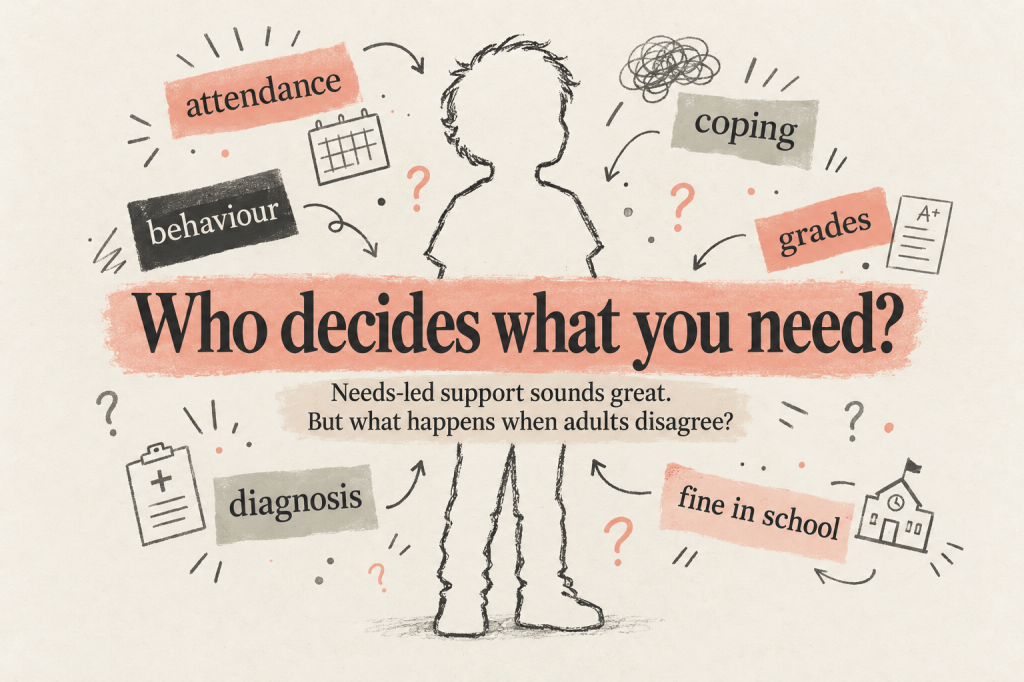
Three words have been everywhere since the autism, ADHD and mental health review was published:
Needs-led support.
And at first glance, it sounds exactly right.
Support the person in front of you.
Don’t make them wait months or years for a diagnosis before anybody does anything useful.
Don’t let a child deteriorate while everyone waits for a referral, an assessment, a report or the right piece of paperwork.
I am completely on board with that.
The review itself recommends moving away from a system that is too dependent on diagnosis and towards a “needs-led plus diagnosis” model, where support can begin earlier and diagnosis happens alongside it rather than acting as the only doorway to help. The Government has now publicly backed that general direction too. GOV.UK
But SEND parents learn to ask another question very quickly.
Who decides what counts as need?
Because that bit matters enormously.
“Needs-led” sounds simple until people disagree about the need
If everyone looking at a child saw the same thing, perhaps this would be straightforward.
But they don’t.
A parent may see a child come home and completely fall apart.
School may see a child sitting quietly at a desk.
A child may be attending every day but using every bit of their energy just to get through it.
A teacher may see compliance.
A parent may see shutdown.
A professional may see “mild difficulty”.
The child may feel like they are barely hanging on.
So when we say support should be based on need, the next question has to be:
Whose understanding of that need counts?
Because if need is measured only by what a child looks like in one classroom at 10:30 on a Tuesday, some children are going to disappear all over again.
We already know this happens
The review itself acknowledges this problem.
Its education chapter talks about children whose difficulties are masked in the classroom or emerge mainly at home, and acknowledges that parents may not be believed when a child appears to be coping in school.
That is not a small detail.
It is one of the biggest problems families of masking children face.
Because “fine in school” can become shorthand for:
No need.
When what it may actually mean is:
The cost is being paid somewhere else.
At home.
At bedtime.
In the car.
At the weekend.
In the refusal to go in the next morning.
In the child who holds everything together until they are somewhere safe enough to fall apart.
That is still need.
Need is not the same as visible crisis
This is where I think the review gets something very important right.
It says needs-led support should take account not only of outward functioning, but also of distress being sustained at considerable personal cost, along with severity, complexity and the risk of deterioration.
That matters.
Because historically, systems have often waited for the visible collapse.
Attendance drops.
Behaviour escalates.
The placement breaks down.
The child stops leaving the house.
Only then does everybody agree something is wrong.
But by that point, families are no longer asking for early help.
They are asking for rescue.
A genuinely needs-led system has to be able to recognise difficulty before everything falls apart.
But there is another danger
The review itself warns about this too.
If we create a new system for describing or measuring need, that system must not become another hurdle or another way of rationing help.
That is important enough to repeat.
Because SEND parents have seen this pattern before.
A new framework arrives.
A new threshold appears.
A new form is introduced.
A new “graduated response” is created.
And somehow the support is still just out of reach.
So when people say:
“You won’t need a diagnosis anymore. Support will be based on need.”
parents are entitled to ask:
What happens when the service says the need isn’t high enough?
What happens when the parent and school disagree?
What happens when one professional recognises the need and another does not?
What happens when the right support exists on paper but not locally?
What happens when budgets are tight?
And most importantly:
What can a family actually do when the support is not provided?
That is where legal rights matter.
Needs-led must not mean rights-light
This is the part I will be watching very closely as SEND reform develops.
There is currently significant concern about what future reform could mean for EHCPs and enforceable SEND rights.
Recent reporting suggests families are already rushing to secure EHCPs because of uncertainty about what future arrangements will look like. The Guardian
That reaction tells us something.
Parents do not chase statutory plans because filling in forms is a hobby.
They chase them because an EHCP currently gives a child individual legal entitlement to specified provision.
When trust in ordinary provision is low, legal enforceability becomes incredibly important.
So if the future system offers earlier help and makes families less dependent on diagnosis or EHCP applications, brilliant.
That would be a genuine improvement.
But only if:
the support is actually there;
the assessment of need is fair;
families are listened to;
children who mask are not overlooked;
specialist provision remains protected;
and there is still a meaningful route to challenge decisions when things go wrong.
Otherwise “needs-led” risks becoming:
Here is what we have available. Therefore this is what we have decided you need.
And those are not the same thing.
Who decides?
This is the question I keep coming back to.
Because the principle is right.
Of course support should be based on need rather than making people wait for a label.
But “need” is not an objective little number sitting inside a child waiting for somebody to measure it.
Need is shaped by the child.
The environment.
The demands being placed on them.
Their ability to communicate distress.
How much they are masking.
What support is already around them.
And how much effort it is taking simply to appear okay.
That requires people to listen.
Not just to professionals.
Not just to attendance data.
Not just to what is visible in school.
But to the child.
To the family.
And to what happens across the whole of their life.
The idea is good. Implementation is everything.
The Government has said it wants earlier support based on what is happening in people’s lives rather than making them wait for diagnosis, and says its SEND reforms will also move towards a needs-led approach. GOV.UK
That could be hugely positive.
But one of the strongest responses to the review this weekend has been a simple one:
Where is the capacity to make it happen?
Because you cannot create meaningful early intervention through wording alone.
You need people.
Time.
Training.
Specialist services.
Therapists.
Educational support.
Community provision.
And money.
Commentary since the review was published has already raised exactly that concern: a needs-led system sounds promising, but without adequate investment it risks becoming another reform that changes the language without changing families’ actual experience. The Guardian
And that is probably where I land too.
I want a needs-led system.
I want children helped before they reach crisis.
I want schools to respond to difficulty without needing a diagnostic report first.
I want parents to stop having to prove, repeatedly, that what they are seeing is real.
I want diagnosis to be available when it is needed without being the only key that opens every door.
But I also want to know that “needs-led” means the support follows the child.
Not that the definition of need quietly shrinks until it fits the support the system can afford to provide.
Because there is a very big difference.
A note on this article
This is my commentary on the Independent Review into prevalence and support for mental health conditions, ADHD and autism and the Government’s initial response to it.
The review recommends a move towards a “needs-led plus diagnosis” model and explicitly warns that describing need more consistently must not become another barrier or mechanism for rationing support.
The Government has welcomed the move towards earlier needs-led support, but the detail of how that will operate — including its relationship with future SEND reform, statutory entitlements and local provision — is still developing.
This article reflects my interpretation of what parents may reasonably want clarified as those reforms progress.
Further reading
Independent Review into prevalence and support for mental health conditions, ADHD and autism — Final Report
Read the full report on GOV.UK
Government response — 9 October 2026
Government pledges earlier support to tackle mental health crises
Ministerial speech on the review and needs-led support — 9 October 2026
Read the speech on GOV.UK
I’d publish this one. It follows Friday’s report piece without duplicating it, and it moves Have You Tried? from “here’s what the report says” to “here’s the question families should be asking next.”


Leave a Reply