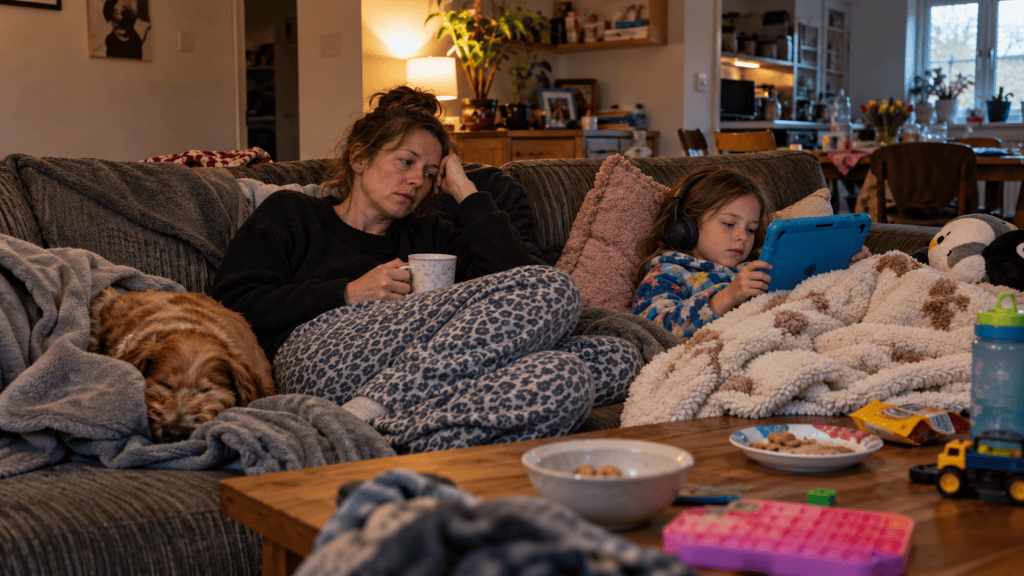
Half term.
A whole week off school.
No alarms.
No packed lunches.
No school run.
No uniform battles.
No trying to work out whether “I don’t want to go” means tired, anxious, overwhelmed, ill, dysregulated, or all five before 8:15am.
Lovely.
And then somewhere around 10:07 on day one you realise:
Oh. I am now the entire timetable.
School can be exhausting. So can having no school.
This is one of those SEND parenting contradictions nobody really prepares you for.
School can absolutely wipe a child out.
The noise.
The people.
The demands.
The transitions.
The masking.
The constant expectation to listen, respond, move, sit, eat, cope, change activity, manage friendships and somehow remain vaguely regulated until home time.
So when half term arrives, sometimes everybody desperately needs it.
The first morning can feel like someone has removed a weight from the house.
No rush.
No shoes.
No trying to persuade someone that yes, unfortunately trousers are still required.
Just home.
Safe food.
Pyjamas.
Screens.
Quiet.
And yet…
School also provides structure.
There is a known beginning.
A known ending.
People tell you what happens next.
There are routines.
There are predictable chunks of the day.
Take all of that away and suddenly you have a child who desperately needed a break from school but also has absolutely no idea what to do with an entire Tuesday.
Both things can be true.
“What are we doing today?”
Nothing strikes fear into me quite like this question before I have finished my first cup of tea.
Because the answer cannot simply be:
existing peacefully.
Apparently.
There needs to be a plan.
Except if I make too much of a plan, that might be overwhelming.
If I make no plan, that might also be overwhelming.
If I suggest something, it may immediately become the worst idea anybody has ever had.
If I don’t suggest anything, boredom may descend upon the house like a Victorian illness.
Half term parenting sometimes feels like being a cruise director for one extremely discerning passenger who did not book the cruise and has several complaints about the itinerary.
Going out is not always the easy option
There is also this slightly strange idea that school holidays are for days out.
Museums.
Farms.
Soft play.
Theme parks.
Cinema.
Swimming.
Pumpkin patches.
Insert wholesome family activity here.
And sometimes that is brilliant.
Sometimes everyone has a lovely day and you come home thinking:
Look at us. Functioning.
Other times you spend forty-five minutes preparing for an outing that lasts nineteen minutes.
You have checked:
how busy it will be;
where the toilets are;
whether there is food your child will eat;
how loud it is;
whether there is somewhere quiet;
how long the journey takes;
what parking is like;
whether there is an obvious escape route;
whether you need headphones;
whether the weather will make the clothes situation impossible;
and whether everyone has enough emotional capacity left to actually do the thing.
Then somebody puts the wrong shoes on and the entire operation collapses before you leave the driveway.
This is not a criticism of the child.
It is just the reality that for some families, going somewhere involves a lot more than getting in the car.
Sometimes children need to do absolutely nothing
I think we put quite a lot of pressure on school holidays.
Make memories.
Have adventures.
Get them outside.
Get them off screens.
Make the most of the time together.
And yes, lovely.
But sometimes the child who has spent seven weeks holding themselves together needs to lie under a blanket watching the same programme repeatedly.
Sometimes they need to wear pyjamas until 2pm.
Sometimes lunch is beige.
Sometimes there is a device involved for considerably longer than anybody on Instagram would approve of.
Sometimes the outing is Tesco.
Sometimes even Tesco is ambitious.
Rest does not have to look productive to count.
And recovery does not have to be photogenic.
The parent does not necessarily get a break
This is the bit hidden inside the phrase:
“Enjoy your week off!”
Because yes, the child is off school.
But somebody is now providing everything school usually structures.
Meals.
Activities.
Transitions.
Regulation.
Company.
Conflict management.
Entertainment.
Movement.
Sensory input.
Downtime.
Bedtime.
And, depending on the child, quite a lot of emotional co-regulation in between.
If you are working, you may also be trying to stitch childcare around a child whose needs do not fit neatly into ordinary holiday clubs.
If you are not working that week, people may assume you are also “off”.
Except you are still very much on.
Possibly more on than usual.
There can be a strange decompression period too
Some children do not skip happily into half term.
They fall into it.
The first couple of days can be messy.
More emotional.
More tired.
More demanding.
More dysregulated.
It can seem odd when the thing causing pressure — school — has stopped.
But bodies do this.
Sometimes you hold everything together until you reach safety.
Then it all comes out.
Adults do it too.
You survive the deadline, the meeting, the difficult week, the stressful situation…
and then get ill on Saturday.
Children are not immune to that.
So the first few days of a school holiday may not look like instant relaxation.
They may look like recovery.
And then just as everyone settles…
It is nearly time to go back.
Excellent.
Now we reverse the entire process.
Bedtimes start creeping earlier.
Uniform reappears.
Questions begin.
What day am I back?
Who will be there?
Are we doing PE?
What if something changes?
Do I have to go?
And suddenly the nervous system that has only just stopped buzzing remembers exactly what Monday means.
For some children, the end of half term is straightforward.
For others, the return starts looming several days before it actually happens.
That does not mean the holiday was a mistake.
It means transitions are hard.
So if your half term looks boring…
Good.
Honestly.
If everybody needs a week of low demand, let it be low demand.
If your child wants to stay home more than you expected, that is okay.
If you booked three things and cancel two, fine.
If you spend more time regulating than entertaining, that counts.
If there are meltdowns despite removing school pressure, you have not failed at half term.
If screens are doing some heavy lifting, welcome to the club.
And if your main achievement is that everybody reaches the other side reasonably intact?
That is still an achievement.
School holidays do not need to become another thing parents feel they are doing incorrectly.
Sometimes the most useful thing about half term is simply this:
For a few days, your child gets to stop trying so hard.
And maybe you can stop trying quite so hard too.
Not completely, obviously.
Someone still has to answer:
“What are we doing today?”
At 8:03 tomorrow morning.


Leave a Reply